30 September 2025
Renewable Energy + EVs: Powering India’s Sustainable Transport Revolution
Imagine this: You pull into an EV charging station in Bengaluru, plug in your vehicle, and notice that the charger is fed from rooftop solar generation instead of coal-based electricity. The best part? The pricing is almost half of the grid tariff—and you're buying clean energy to make it to work.
This isn't science fiction. India is actively shaping its destiny at the crossroads of renewable energy and EVs. With policies ready to be enacted, rapid technological adoption, and decreasing prices, this synergy is rapidly gaining momentum, driving India towards a sustainable transport revolution.
An Unfolding Perfect Storm: Now Is the Time for India
India stands at a pivotal moment for mobility and sustainability.
- EV Boom: The number of EV sales crossed two million in 2024, boasting an impressive 25% year-over-year growth.
- Renewable Expansion: As of March 2025, India proudly holds an installed renewable energy capacity of 220.10 GW, with a remarkable 29.52 GW installed in FY 2024–25 alone.
- Economic Opportunity: The EV market, valued between USD 2.28 billion and USD 8.49 billion in 2024, is projected to skyrocket to USD 113.99 billion by 2029, at a formidable CAGR of 66.52%.
Why now? It all boils down to three key factors: falling prices (a 15% drop in solar panel pricing in 2024), government incentives coming into full force, and soaring demand for cleaner, cheaper transport.
Solar for EV Charging: From Vision to Reality
The idea of solar-powered EV charging was once a distant vision; today, it's a tangible reality.
- Tata Power operates 1,200 solar-integrated EV chargers out of its 5,000 stations nationwide.
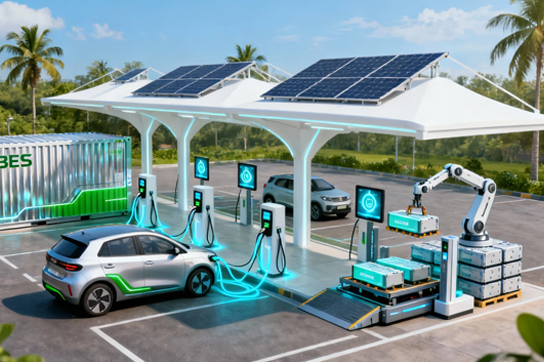
- A solar-activated EV hub recently opened in Bengaluru, featuring a 45 kWp rooftop solar panel system with 100 kWh storage, capable of charging 23 EVs simultaneously.
- The Gurugram solar microgrid, with a 1.2 MW capacity powering 150 fast chargers, demonstrates the scalability of solar solutions.
The economics are incredibly enticing:
- The cost of grid electricity for EV chargers is ₹6–7/unit.
- Solar electricity for EV charging is just ₹2.50–3.50/unit.
For businesses, this translates to lower operating costs. For consumers, it means cheaper charging. For India, it signifies a significant stride towards energy freedom.
EV Charging Infrastructure: A Billion-Dollar Opportunity
While India's charging infrastructure is rapidly developing, a significant gap remains.
- In 2022, there were only 1,800 public charging stations, projected to reach 26,367 in 2025.
- India's ratio: 1 public charger for every 135 EVs.
- Global average: 1 for every 6–20 EVs.
To support an estimated 50 million EVs by 2030, India will need over 1.32 million charging stations, presenting a $10 billion opportunity for investors in renewable-linked infrastructure.
Government support is crucial:
PM E-DRIVE Scheme: ₹10,900 crore allocation, with ₹2,000 crore specifically for charging infrastructure.
Green Charging Initiative: Mandates that 25% of public chargers source at least 50% of their energy from renewables by 2026.
Battery Storage – The Missing Link
One of the major hurdles for clean mobility in India is the lack of sufficient battery storage, as solar and wind energy don't produce power around the clock. India is estimated to need almost 40,000 MW (200,000 MWh) of battery storage capacity by 2030 to provide large-scale EV charging. The good news is that the economics are becoming far more favorable—Battery Energy Storage System (BESS) tariffs have plummeted by nearly 65% in just two years, making storage solutions scalable and accessible.
Meanwhile, innovation continues to transform the landscape. The RE2EV initiative in Bengaluru is giving second-life EV batteries a new purpose, enabling 24-hour solar charging. New business models like Battery-as-a-Service (BaaS) are reducing the upfront cost of EVs by 40% and more, and battery swap networks are rapidly multiplying, with 26,000 swapping stations envisioned by 2026 and an ambitious target of 111,000 by 2030. Falling costs, circular reuse models, and advanced storage technologies are now placing the battery front and center for India's renewable-based e-mobility uplift.
Policies Fueling the Green Shift
Governments have consistently supported the EV ecosystem:
- FAME II Scheme: Subsidized 16.29 lakh EVs with a budget of ₹11,500 crore.
- PLI Scheme: Attracted investments worth ₹29,576 crores, creating nearly 45,000 jobs.
- National Solar Mission: Pledged USD 120M for solar-powered EV infrastructures by 2027.
Alongside these are various state-level incentives:
- Karnataka & Gujarat: Offer zero land conversion fees for land used in EV charging with solar.
- Uttar Pradesh & Maharashtra: Provide subsidies for rooftop solar at EV stations.
Meanwhile, in the renewable energy world, all eyes will be on REI 2025, Asia's biggest renewable energy show. It's expected to showcase the latest clean tech, EV charging solutions, and integrated solar innovations.
The Road Ahead: Challenges & Opportunities
Challenges:
- Higher EV prices: EVs are still about 20% to 30% more expensive than conventional vehicles.
- Reliance on imports: Heavy dependence on extraterritorial sources for lithium and cobalt.
- Lack of standards: Absence of universal standards for chargers and connectors.
Opportunities:
- Solid-state batteries: Could become commercially viable by 2030.
- Vehicle-to-Grid (V2G) technology: Will help optimize India's grid by utilizing EVs as mobile energy banks.
- Scalability: India's renewable energy capacity, by just 3%, could generate enough power for the entire fleet of EVs.
Conclusion: Driving India’s Sustainable Transport Revolution
India stands on the cusp of a generational opportunity to transform mobility with renewable energy and electric vehicles. With over 220 GW of installed renewable capacity, rapidly declining prices, and a vibrant EV market, energy independence, cleaner air, and an economically stronger India are now within grasp.
The loop is self-reinforcing: more EVs → demand for clean charging → more renewable deployment → lower costs → more EV adoption!
It's not going to be "if"—it's going to be "how fast."
And for anyone truly wanting to witness this transition firsthand, there's no better place than REI 2025—Renewable Energy India Expo, where the future of solar energy, EV charging, and India's vision for sustainable transport will be on full display.